I work where enterprise systems meet generative AI.
My profession is SAP S/4HANA transformation, and I am SAP-certified in Financial Accounting. What I understand about agentic AI comes from building the four projects below end to end, covering retrieval, an agent, a pipeline, and an oversight layer, along with the governance, security, and integration questions that come before anything goes live. The AI certifications came afterwards and confirmed that understanding rather than created it.
Day Job
I am an SAP S/4HANA finance consultant, working where process, compliance, and technology meet. That is exactly where enterprises are now putting AI agents to work.
How I Think
I frame the problem, design the solution, and direct AI to build it, but the decisions stay mine. I own the architecture, the testing, the deployment, and the result, while AI provides the execution speed.
Cross-platform
Across platforms, not inside one
I have worked the same patterns across SAP, Microsoft Copilot Studio, and open-source local LLMs, so I understand what sits under every vendor's agents rather than just one, including what it takes to run entirely on local hardware when data cannot leave the building.
The same discipline every time, whatever the tool
Projects
Proof over theory
These four builds are best read in order, because each one solved a real problem on its own and together they add up to one system. I designed and directed them, with AI handling the code under my review, which is the same working model I bring to enterprise teams. The line running down the page traces the route from retrieval to oversight.
Stop 01 · RetrievalLearning in public · local, on-premise
Local LLM (RAG) for immigration questions
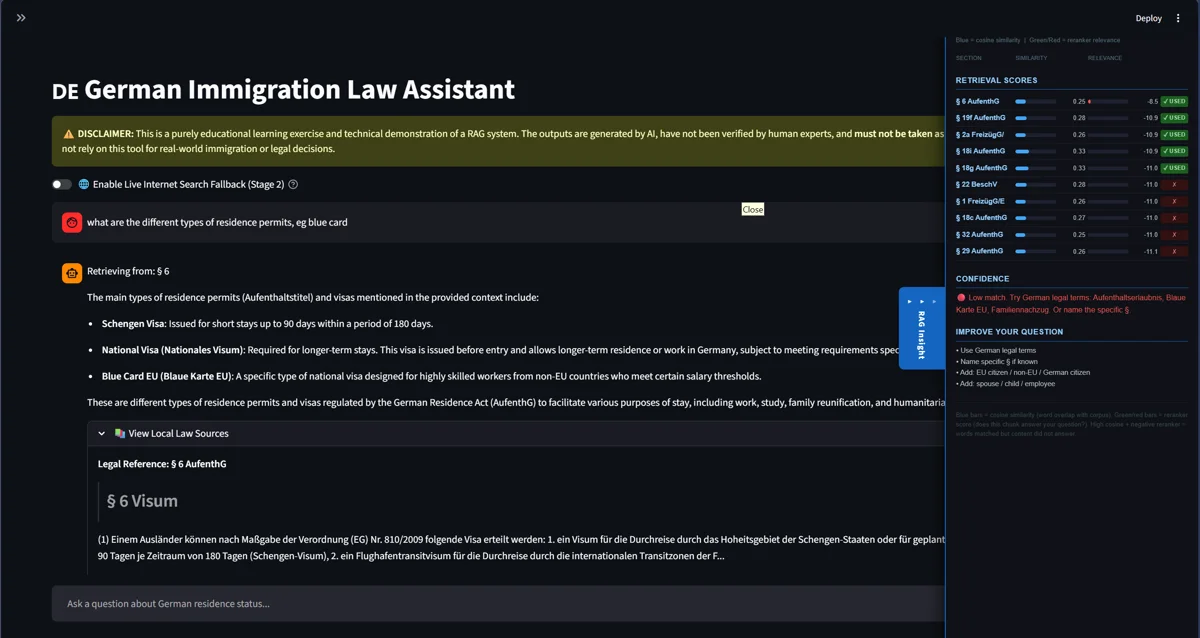
Public AI tools either refused legal questions or invented the law, and my documents could not leave the machine. So I brought the model to the data and built an assistant that answers only from the statute text it retrieves, citing every claim. Everything that follows depends on this stop, because an agent is only as trustworthy as what it reads.
The problem. Standard AI assistants either refuse to answer legal questions or invent rules that do not exist. German immigration law spans multiple statutes with hundreds of cross-referenced sections; a single eligibility question can require reading five different parts of the law at once.
What I built. A system that runs entirely on local hardware, so no data ever leaves the machine, GDPR compliance by design. It retrieves the most relevant legal sections for any question and generates an answer grounded only in those sections, citing exactly where each point comes from.
Enterprise parallel: grounded assistants over SAP, finance, and compliance documentation, on-premise where data cannot leave the building.
Stop 02 · The agentActively used · live, serverless
Family finance and goals AI agent
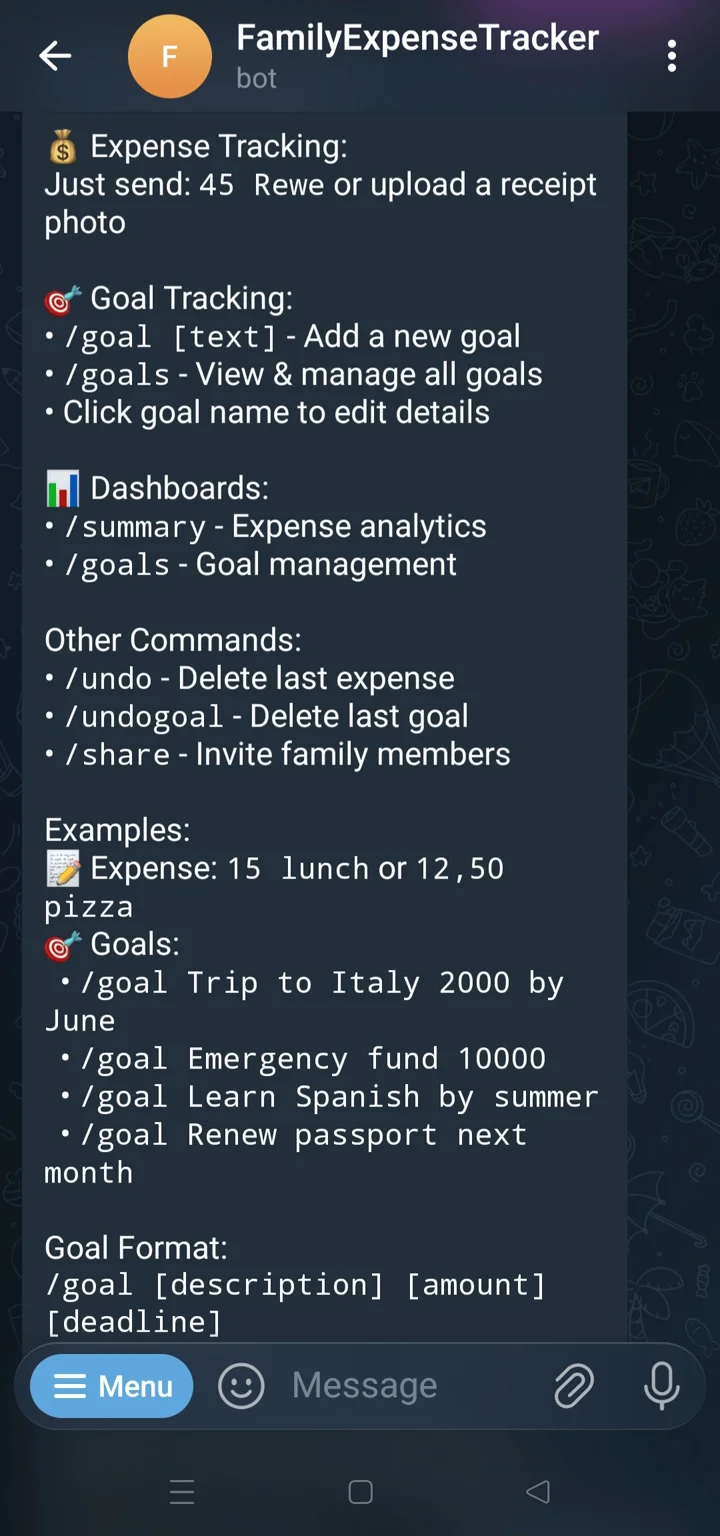
Expense logging in our family was cumbersome because the app had too many steps, so I built an AI agent that turns a message or a photo of a receipt into a row in the shared sheet in under a second. The lesson for me was that an agent has to do more than understand a request; it has to complete the action and leave the result where people already look.
The problem. Logging a family expense means opening an app, finding the right category, and typing it manually. That small effort is easy to postpone, and weeks of spending can go untracked. Goals follow the same pattern: written down once and rarely revisited.
What I built. An AI agent on Telegram that reads a message or a photo of a receipt and writes the expense directly into a shared Google Sheet in under a second. Goals work the same way: one natural-language message creates a tracked entry. Zero apps, zero manual effort.
Enterprise parallel: conversational agents that capture transactions and post them into enterprise systems.
Stop 03 · The pipelineLearning in public · open source
Portfolio rebalancer
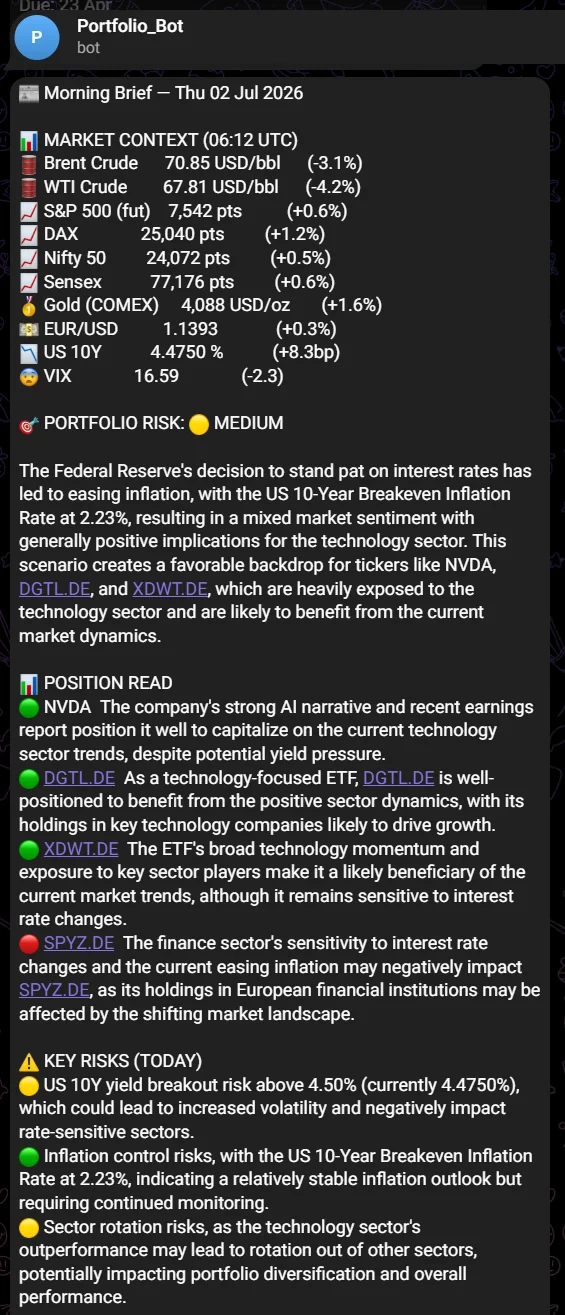
The truth about my own portfolio was locked in a broker PDF, so I built a tool that reads the statement, prices every holding, measures the risk, and names the trades that would close the gap to target. It turned a document into a decision, which is the kind of pipeline finance teams everywhere are starting to need.
The problem. An ETF portfolio drifts away from its target allocation as prices move, but the holdings sit locked inside a broker PDF, and the maths to quantify the drift, and the risk that comes with it, is tedious and error-prone to do by hand.
What I built. A Python tool that parses a broker statement into holdings, resolves each position to a live price from Yahoo Finance, computes risk metrics such as Sharpe, Sortino, max drawdown and VaR, then reports the buy and sell trades that would close the gap to target, with an optional LLM narrative. It is educational only: it never places trades and is not investment advice.
Enterprise parallel: document-to-decision pipelines that read statements and surface actions for finance teams.
Stop 04 · OversightConcept demo · live, multi-system
TreasuryFlow: governance and visibility
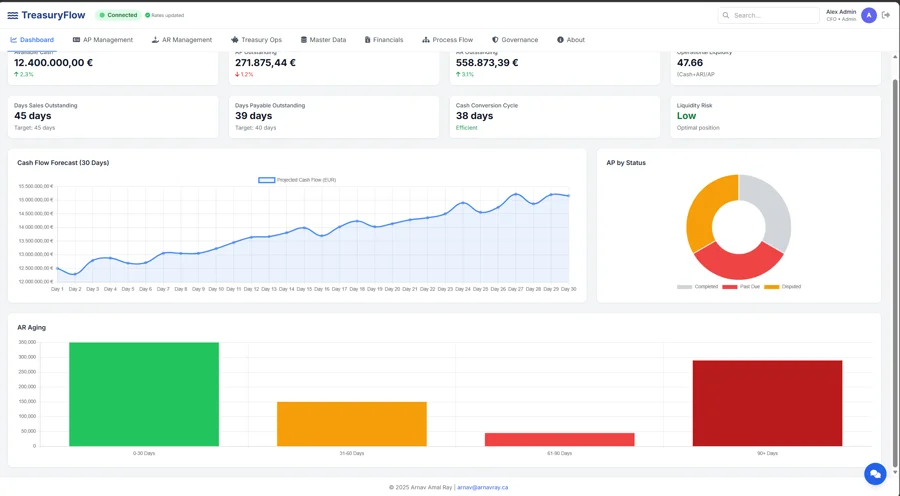
Once agents start acting on real data, someone has to be able to see everything they do. TreasuryFlow pulls payables, receivables, and cash into one live view so that a human can watch what is happening and own the result. This oversight layer is what makes the other three builds safe to run.
The problem. Once agents and pipelines are acting on finance data, the missing piece is oversight, one trustworthy view of what is happening across systems, so a human can see and own the result.
What I built. A personal concept demo that pulls AP, AR, and cash positions via API into one live dashboard. It is the oversight layer over the other three building blocks. It is a personal concept demo, separate from any client or employer work.
Enterprise parallel: the governance and visibility layer over a system of finance agents.
Destination
Read together, the four builds are one system. Retrieval grounds what the agent knows, the agent acts on it, the pipeline turns documents into decisions, and the oversight layer watches the whole. That is what I mean by agentic enterprise finance.
Where this is going
The tools for building agents are arriving fast from SAP and every other vendor. As they become more autonomous, the scarce skill will not be building one, but understanding the consequences well enough to set the boundaries, prove the output is correct before it goes live, and own the result. That is the work I focus on.